Rehearsed or Merely Read: Testing Continuity Before You Need It
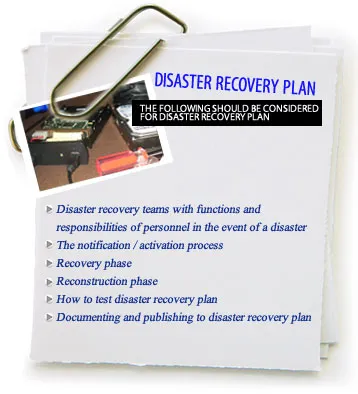
Photo: Shameem at English Wikibooks, Public domain, via Wikimedia Commons
Most UK service agreements contain a continuity clause. Far fewer contain a continuity capability. The distance between the two is rarely a drafting failure; it is an evidence failure. The plan exists, it has been circulated, it has been summarised in a slide, and nobody has watched it operate under load.
For boards, that is an uncomfortable position. A commitment to recover a service within a stated period is a performance claim like any other, and performance claims should be testable. The question is not whether the supplier has a document. It is whether anyone can demonstrate, with dated records, that the document has been executed.
Three kinds of exercise, three very different assurances
Continuity testing is often described as a single activity. In practice it comes in three forms, and only one of them produces meaningful assurance.
A tabletop walkthrough gathers people in a room and talks through a scenario. It tests whether individuals know their roles and whether the escalation route is understood. It tests nothing about systems, data or timing.
A component test exercises one element in isolation: a backup restoration, a failover to a secondary site, a switch of a communications provider. Useful, but silent on how the pieces behave together.
A full simulation takes a defined scenario, runs it against live or realistic data, involves the parties who would actually be present, records the elapsed time against the contractual targets, and produces a written outcome. This is the only form that generates evidence a board can rely on.
If the assurance report says the plan has been tested but cannot say which of these three took place, the answer is usually the first.
What a credible test contains
A test worth the name tends to share a set of characteristics. It has a named scenario and a defined trigger, not a generic reference to a major incident. It has a scope that states which service, which site, which supplier and which population of users are in play. It works to recovery time and recovery point objectives drawn from the contract rather than invented for the occasion.
It involves the third party directly. A frequent weakness is a test in which the supplier's service manager relays messages to technical staff who never appear, leaving the buyer with a narrative rather than a log.
It is timed. Elapsed minutes are recorded at each stage, including the awkward period before anyone decides to invoke the plan. It includes a reconciliation step, so that restored data is checked against the source rather than assumed to be complete. And it ends with a report that lists what failed as well as what passed, with actions, owners and dates.
The artefacts that survive scrutiny
Evidence is what remains after the meeting. Buyers should expect to hold, or at least be able to inspect, the following:
- A dated test plan, approved before the exercise, setting out scenario, scope and success criteria.
- Restoration or failover logs showing timestamps from the systems involved, not a summary written afterwards.
- A decision log recording who authorised each step and when.
- Attendance records, signed, including which organisations were represented.
- Any communications issued during the exercise, with times.
- The post-exercise report, with an action tracker and named owners.
- Closure evidence for the actions, and a scheduled re-test date.
A supplier that can produce the first, third and sixth items but not the second is describing a discussion, not a test.
Four questions that separate the two
Did the exercise restore, or verify? Confirming that a backup exists is not the same as restoring from it. The second takes time, and time is what the contract promises.
Was it timed against the clause? A test that recovers the service in eleven hours is valuable evidence if the commitment is eight hours, and much less valuable if nobody noticed the difference.
Were the actions closed? A report with twelve open actions and no closure evidence is a description of known weakness, not a source of assurance.
Was the scenario uncomfortable? Tests built around convenient scenarios tend to succeed. A scenario that removes the person everyone relies on, or starts at two in the morning, tells you more.
Bringing it into the board cycle
The practical remedy is unglamorous. Place the continuity exercise in the assurance calendar alongside the financial and compliance items. Ask each year for the current test report, the open actions from the previous one, and the date of the next. Note in the minutes whether the test was a simulation or a discussion. Where the answer is the latter, record it as a gap rather than a comfort.
Continuity is one of the few service promises that is only ever tested on the worst day. A plan that has been rehearsed, timed, logged and corrected is an asset. A plan that has only been read aloud is a hope with a version number.